BlackRock is about to launch $BITA, its brand new Bitcoin ETF focused on passive income (Covered-Calls). We explain how this product will change the game for the crypto market.
The institutional investment barometer remains in the red. At a time when bitcoin is trying to stabilize after many weeks of turbulence, US spot Bitcoin ETFs face a new wave of large-scale withdrawals. Since early June, these investment vehicles have lost more than 2.1 billion dollars, a sign that raises questions about investors' appetite for the world's leading crypto.
Despite a legal ban in force since 2021, crypto flows in Nepal briefly exceeded 13% of GDP that same year. In a report published on June 10, 2026, the International Monetary Fund (IMF) sounds the alarm and asks the Kathmandu authorities to establish a regulatory framework compliant with international standards. How will the authorities manage this fait accompli.
The historic holders of Cardano (ADA) are coming out of their lethargy. On-chain activity peaks, massive exits from exchanges… do these movements announce a rebound or just a redistribution? Dive into the data analysis to understand what is being prepared.
The digital asset market is going through a difficult period. In recent weeks, bitcoin has come under increasing pressure as several sources of demand have slowed simultaneously. On one hand, capital outflows from US spot bitcoin ETFs continue. On the other hand, companies that typically accumulate cryptocurrency reserves have sharply reduced their purchases. This combination helps maintain a cautious climate around the market.
Bitget has launched Universal Cup, a football-themed global campaign with a 250,000 USDT prize pool. The initiative turns a major sporting moment into an interactive community game, where users represent countries, score points and compete on live leaderboards.
The CME Group started trading futures contracts on the Nasdaq CME Crypto index on June 9, covering eight leading digital assets. This product responds to an institutional demand that goes far beyond the bitcoin/ether pair alone. Traditional finance is, once again, setting its milestones in the crypto universe.
The debate on Ethereum's future is accelerating around a major technical goal: making Zero-Knowledge the foundation of its architecture in order to make the protocol faster, more affordable, and more secure. Joseph Lubin, CEO of Consensys, believes this transition could transform the network's base layer and bring layer 2s closer into a more unified ecosystem. According to him, Ethereum could become a protocol entirely based on Zero-Knowledge proofs within the next five years.
Every price movement in the bitcoin market results from a constant struggle between the available supply and the demand able to absorb it. If this balance is broken, even temporarily, prices can quickly feel the effects. This is exactly what a recent analysis shows. Some institutional players have now sold the equivalent of nearly 450% of the daily production of bitcoins. A figure that raises concerns as the market tries to maintain its balance in an increasingly uncertain financial environment.
Bitget is turning user protection into a central part of its multi-asset strategy after helping users recover $32.3 million linked to scams and security incidents. With Anti-Scam Month 2026, the exchange wants to make fraud prevention as visible as product innovation.
Kalshi tightens its rules against insider traders with three new surveillance measures. The platform aims to protect its predictive markets as their influence grows in the crypto ecosystem.
The European Union (EU) targets crypto platforms complicit with Russia in its 21st sanctions package! A historic measure that could disrupt markets and redefine the economic war.
Tim Draper, a historic investor known for his sharp predictions on Bitcoin, recently dismissed fears around quantum computing. According to him, traditional banks will fall under quantum blows well before the blockchain. Do BTC holders really have less to fear than bankers?
The crypto market regularly experiences phases of euphoria and disappointment, but certain indicators help identify moments when investor sentiment truly breaks down. For XRP, the latest data published by Glassnode indicate that such a breaking point may be underway. The on-chain analysis company observes both an explosion in loss sales and a sharp contraction in network activity, reflecting a profound change in market dynamics.
Bitcoin loses billions in flows in 2026. Bernstein has just put the figures on the table. And they are conclusive. Decryption.
Bitget is pushing tokenized equities into a more practical phase with Stocks 2.0, an upgraded spot product built to connect stock-linked tokens with real U.S. market liquidity. The launch marks another step in the exchange’s Universal Exchange strategy, where crypto, equities, ETFs, commodities and other assets move inside one trading environment.
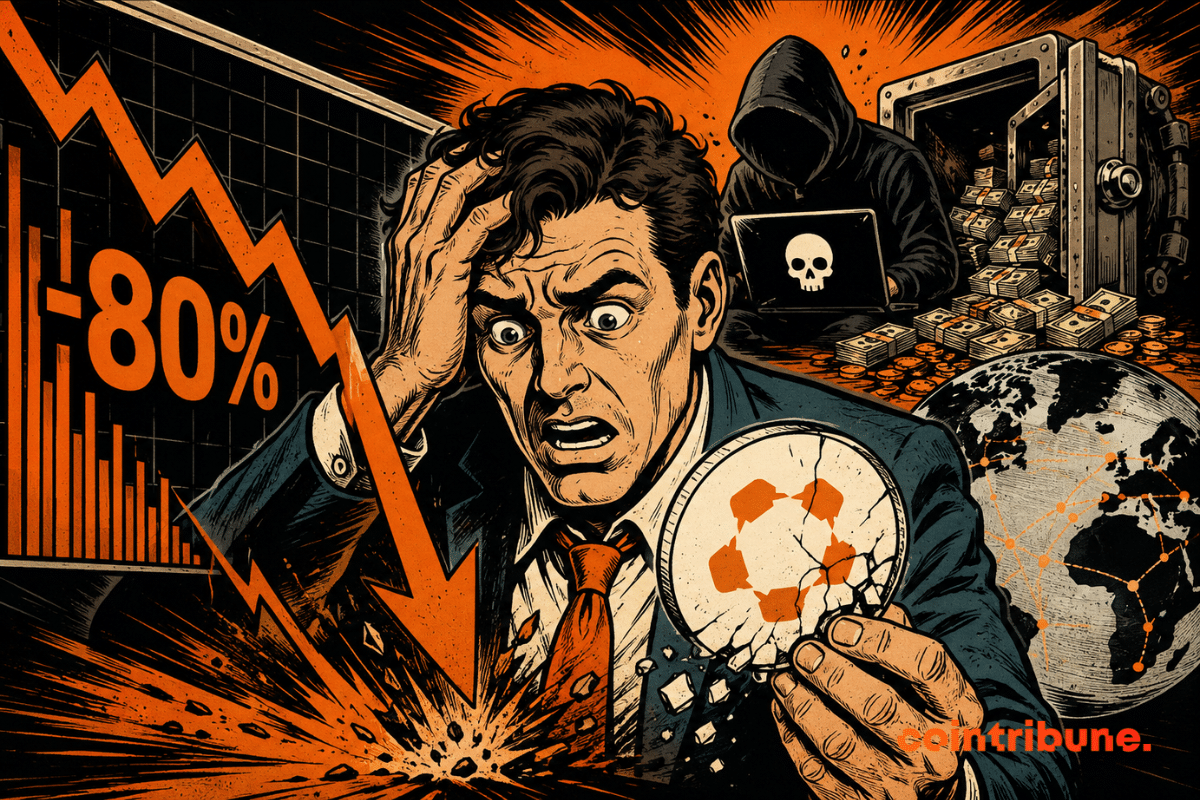
The cryptocurrency sector faces a new major security incident. Humanity Protocol, a project specializing in decentralized identity, has suffered a significant compromise leading to the theft of over $32 million. Following this attack, the H token lost more than 80% of its value within a few hours. The event once again highlights the risks related to private keys, now at the center of several major attacks observed this year.
In April 2026, a flaw in KelpDAO's LayerZero bridge triggered $8.45 billion withdrawals on Aave in less than 48 hours, the biggest banking panic in DeFi history. Stani Kulechov, founder of Aave Labs, presented the episode as proof of the protocol's robustness at the Proof of Talk in Paris. However, the facts paint a much less flattering picture.
Russia wants to tax and regulate Western cryptocurrencies deemed "hostile." Behind this measure, Moscow is primarily seeking to regain control of a crypto market that has become strategic for its payments, exchanges, and financial sovereignty.
Ethereum has lost more than 65% since its August 2025 record. Bitmine already shows about 9 billion dollars in unrealized losses. And yet, Tom Lee's company has just made its biggest weekly ETH purchase of the entire year 2026. A conviction that demands respect, or raises concern.
A few days after fueling speculation with a rare bitcoin sale, Strategy is already back on the path of accumulation. The company led by Michael Saylor has just acquired 1,550 additional BTC while raising its cash reserve to one billion dollars. A dual operation that dispels doubts about its commitment to bitcoin and reveals a more discreet evolution of its financial strategy. Between strengthening its BTC reserves and consolidating its balance sheet, the company refines its model at a time when investors scrutinize every decision of the major institutional players in the market.
Why is bitcoin falling when no major bad news seems capable of justifying such a correction? This is the question troubling investors today after the collapse of more than 50% of the leading crypto since its peak of 126,000 dollars. For NYDIG, the explanation is not found in a single event, but in the accumulation of several rarely combined factors: enthusiasm for artificial intelligence, expectations around future tech IPOs, quantum-related fears, and unfavorable psychological signals. A combination that could shed light on the current market weakness.

Zcash wants to restore trust with Ironwood, a new shielded pool designed to fix the gray area left by the Orchard flaw. In an already nervous crypto market, the issue goes beyond a simple technical bug. It touches the heart of ZEC's promise: a private currency, but one whose supply must remain verifiable.
Bitcoin revives Kalshi's activity and propels its weekly open interest to a record level. Behind this figure, a trend is emerging: predictive markets are becoming a new thermometer for crypto sentiment. They do not replace traditional derivatives. But they now capture a visible part of the nervousness around BTC.
The week of June 8 subjects the crypto market to a particularly busy macro calendar, between the release of American inflation on Wednesday and the ECB decision on rates on Thursday. After nine months of correction, digital assets remain under pressure in a context of divergence with stock markets at their peak. Will bitcoin finally find a floor this week?
Criticism surrounding the Ethereum Foundation has been increasing for several weeks. Budget cuts, internal departures, and leadership changes are fueling debates within the blockchain community. However, Joe Lubin refuses to speak of a crisis. According to the network co-founder and CEO of ConsenSys, these adjustments rather reflect a necessary evolution of the foundation's role.
Cold spell for crypto in Washington! The CLARITY Act, a historic bill to regulate the U.S. market, sees its chances of adoption collapse according to Galaxy Digital. We explain why panic is looming among investors.
Since its peak in October 2025 at $126,000, Bitcoin has lost more than 40%. The Fear & Greed index is in the extreme fear zone, institutional ETFs are recording net outflows, and obituaries are blooming again. Yet, bitcoindeaths.com already counts 472 since 2010. They all appear at the same time: exactly this one.
Michael Saylor has not finished confusing the crypto market. A few days after the exceptional sale of 32 BTC by Strategy, a first in several years, the company's co-founder rekindled speculation with an enigmatic message published on X. Behind this simple sentence lies a question that now agitates investors: is the largest bitcoin holding company in the world already preparing to resume its offensive on BTC?
In a crypto market dominated by capital outflows, XRP stands out as an exception. While investment products linked to Bitcoin and Ether experience withdrawals, funds backed by Ripple's token continue to attract new capital. This dynamic contrasts with the overall market sentiment and draws the attention of institutional investors.