Bitcoin fell from 81000 to 62000 dollars in a few days after the failure of its last recovery attempt. The problem now goes beyond liquidations: the price rebounds occasionally, but spot demand, ETFs and available liquidity do not recover.


As bitcoin plunged to $62,006, rumors of a liquidation orchestrated by Binance ignited the web. Changpeng Zhao (CZ) breaks the silence to set the record straight and point out 5 real culprits.
Michael Saylor rekindles expectations around Strategy's purchases as the market goes through a new phase of decline. On November 15, the leader published a chart suggesting that the company could take advantage of the pullback to strengthen its bitcoin reserve. This publication comes at a sensitive time, as the value of its holdings remains below the acquisition cost. Meanwhile, Strategy highlights the performance of its preferred shares in a fragile and now highly volatile market as well.
Forced exit from the European market on July 1st, record hacking of 6.3 billion dollars on October 29th, French accounts closed on December 31st: Binance's 2026 pushes many users to move their cryptos. The transfer to another platform takes place in five steps, provided that two or three errors are avoided. Here is the procedure to follow towards OKX, and what the platform really offers to those who arrive. The latest episode, the closure of Binance's French accounts, revives the question.
In the night from November 14 to 15, 64,000 Bitcoin mining machines were hacked to divert 13 EH/s of computing power, exactly as the network recorded a drop in mining difficulty.
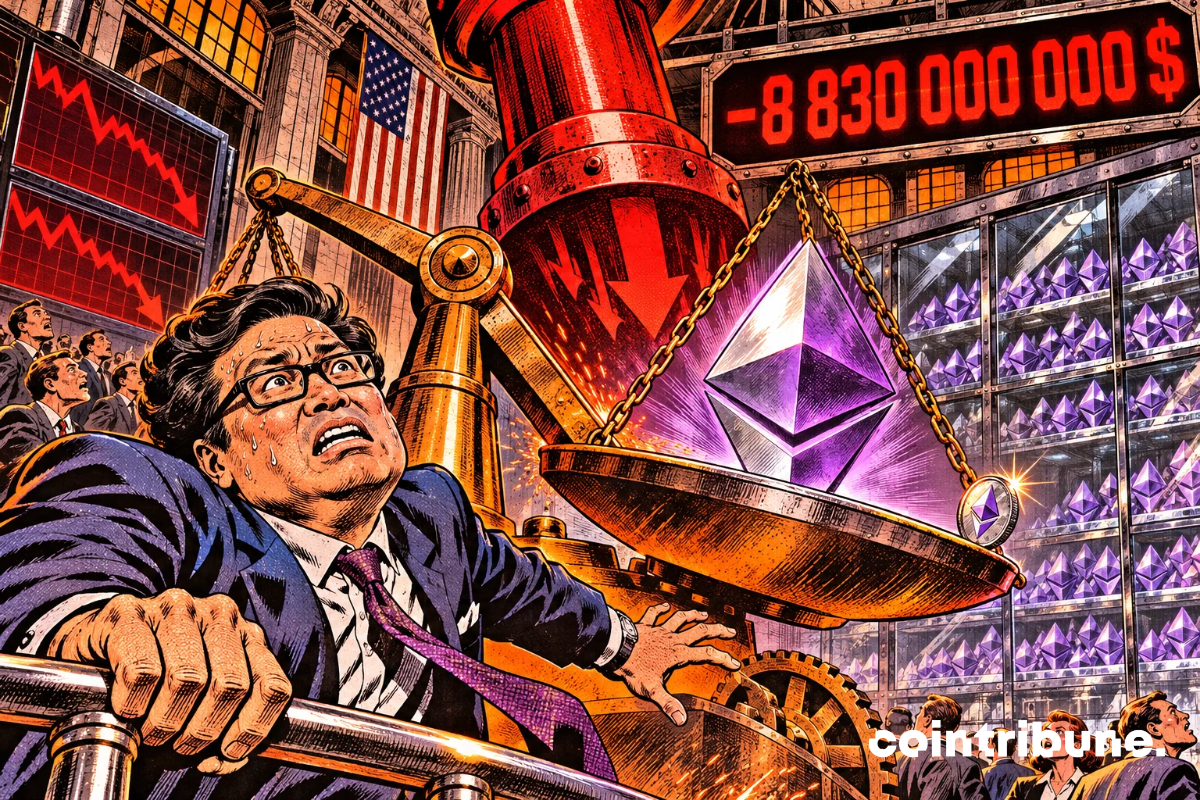
BitMine would show nearly 8.83 billion dollars of latent losses on its Ethereum reserves, according to an estimate released on November 13, 2026. The figure has stirred the crypto market, but it deserves clarification: the calculation uses an average purchase price dating from August and assets declared in November. It therefore does not correspond to a loss officially announced by the company.
Tom Lee proposes three possible explanations for the crypto crash: the drop in values related to artificial intelligence, the preparation of Anthropic's IPO, and the consequences of the Binance hack. These hypotheses remain unconfirmed, but they describe the same mechanism. When investors need liquidity, bitcoin becomes one of the first assets sold.
Qubic's scientific team does not hand-design the brains of its Neuraxon agents: it lets evolution search for them. For ARC-AGI-3, the interactive benchmark of the ARC Prize 2026, the team tested more than 110 configurations and millions of evolved brains on about 500 CPU cores, with no GPU and no pretrained model, according to Neuraxon Intelligence Academy Vol. 14. Its best offline score reached 0.38, and its latest Kaggle submission scored 0.41. This guide explains how evolutionary neural architecture search works, how Neuraxon brains play ARC-AGI-3, what the experiments revealed, what Neuraxon 3.0 will search for next, and how to download the code and the 603,054-row dataset behind it.
IREN, Core Scientific and TeraWulf nearly doubled their artificial intelligence (AI) related revenues in the third quarter of 2026. Together, the three companies generated approximately $478 million through AI cloud and colocation, compared to $239 million in the previous quarter. Meanwhile, their combined Bitcoin hashrate dropped from 32.8 to 16.8 exahash per second (EH/s). The figures show that the shift to AI has now moved beyond the announcement stage.
Bitcoin accumulates as many recovery factors as bearish threats. However, these forces do not follow the same timeline. Sales, ETF outflows, and monetary tightening are already acting, while most bullish catalysts remain hypothetical.
Four nonprofit organizations filed, on November 12, 2026, a complaint against five artificial intelligence groups: OpenAI, Anthropic, Google, Meta, and SpaceX. They ask the California court to block the development and deployment of models more powerful than the most advanced systems of each company as of the filing date. The procedure also targets the use of AI to design its own successors.
Nvidia's management is going through a period of great uncertainty since the announced departure of Jensen Huang. An independent petition now calls for his return to lead the chipmaker, with public support from Elon Musk. As of November 14, the initiative had exceeded 120,000 signatures, including several thousand attributed to employees. Signatories denounce the lack of information and worry about possible consequences for employees, customers, and investors in the technology and financial sectors internationally.
Bitcoin was trading at 64,428 dollars on Saturday, a decrease of 21.2% over one month. At the same time, Michael Saylor highlighted the performance of STRC, Strategy’s preferred dividend stock, to emphasize its resilience against the crypto crash. Its chart shows exact figures. However, a comparison period somewhat spoils the picture: over three months, bitcoin performs better than STRC.
Bitcoin has returned to an area some analysts consider attractive after its drop below 65000 dollars. But a lower valuation does not automatically create a floor: between the withdrawal of capital and still open leveraged positions, the market could first be drawn towards 60000 dollars.
The cryptocurrency market is going through a phase where price movements could become more difficult to anticipate. Behind the fluctuations of Bitcoin and Ether, market makers' hedging strategies play an important role. According to Greeks.Live data, their exposure to options currently presents a configuration likely to accentuate movements in both directions. This situation particularly concerns the derivatives markets and could trigger chain reactions during upcoming fluctuations.
XRP fell below one dollar for the first time since August, after losing nearly 38% from its October peak. More than a psychological threshold, this break changes the market structure: each rebound towards one dollar can now face sellers looking to break even.
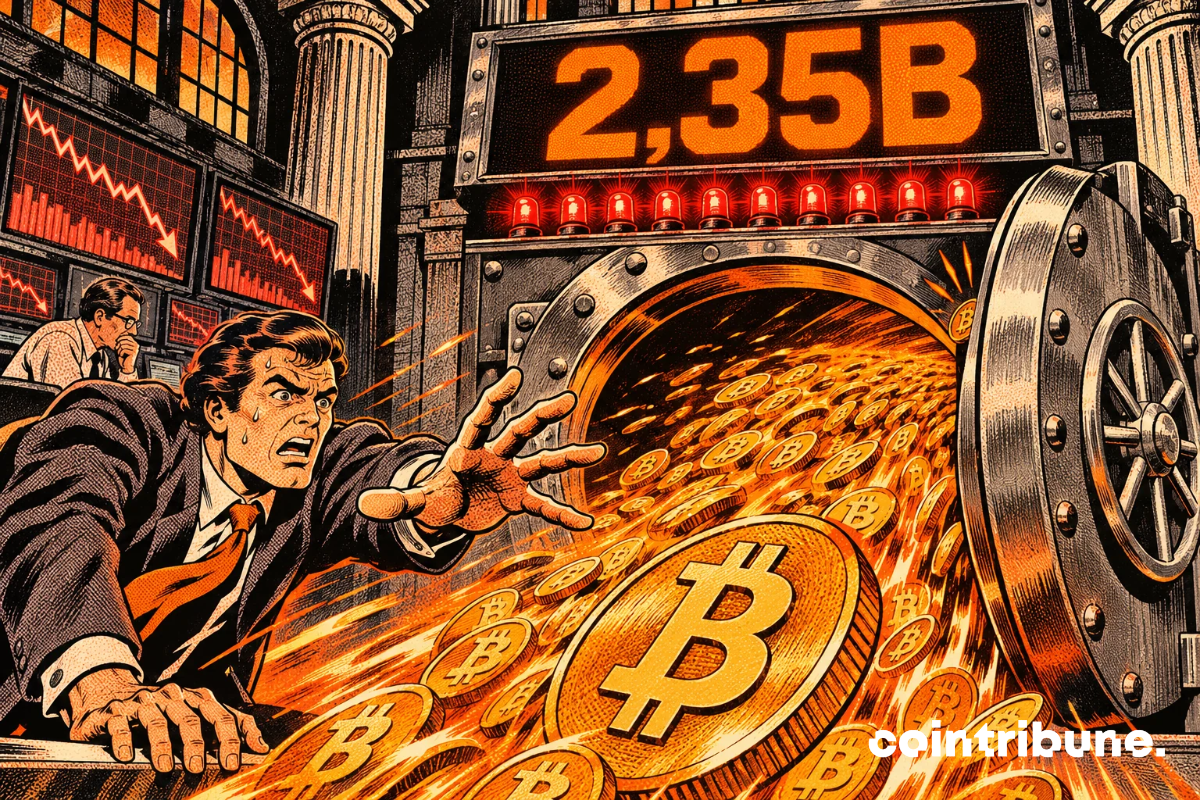
BlackRock suffers a new wave of withdrawals from its Bitcoin ETF. Between October 30 and November 13, 2026, its IBIT fund recorded $2.35 billion in net outflows over eleven consecutive sessions. American Bitcoin ETFs also lost $2.35 billion over the past two weeks. This capital flight comes as BTC fell below $69,000 and investors reduce their exposure to the crypto market.
Bitcoin fell to its lowest level in twelve weeks, wiping out most of its summer rebound. However, the Fed has not yet decided on any hike in December. The market is already correcting the easing scenario on which part of the recovery was based.
Meta advances in the field of prediction markets, already heavily frequented by crypto players. Mark Zuckerberg's company is testing an application called Takes, which allows betting virtual points on future events. Unlike Polymarket and Kalshi, no real money is involved. The project remains reserved for Meta employees, with no announced public launch date.
The cryptocurrency market is looking for a foothold after several sessions of decline. Bitcoin is trading around 69,000 dollars, while investors evaluate the latest US inflation figures. For Matt Mena, strategist at 21shares, a return to 87,000 dollars remains possible, with a move above 90,000 dollars in the longer term. However, this outlook depends on specific technical levels and a sustained return of buyers to the market.
The United States obtains a court order targeting over $1.2 billion stolen from Binance during the October 29, 2026 hack. The DOJ also dismantles the infrastructure of a North Korean campaign that stole $400 million in crypto.
OpenAI launches ChatGPT Wallet, a wallet that allows an AI agent to finalize a purchase with a Visa, Mastercard, or American Express card. The innovation is not just paying from ChatGPT. It creates an explicit boundary between what the AI prepares and what the user authorizes.
Kalshi could soon reach a new milestone. According to Bloomberg, the American predictive markets platform is discussing a new funding round that would raise its valuation to 65 billion dollars. Yet, just one month after raising 1 billion at a 40 billion valuation, the company still has to resolve several regulatory battles. Its IPO is not expected before 2027.
Michael Saylor believes that Bitcoin's simplicity allows it to resist attacks assisted by artificial intelligence. However, his argument protects the protocol more than the bitcoins themselves: AI does not need to break SHA-256 if it can steal a private key or deceive a custodian.
Since October 29, 2026, Kraken Prop users can trade six commodities: gold, silver, WTI oil, Brent oil, copper, and natural gas, 24/7, according to Kraken's blog. At the same time, the commission on all non-crypto markets drops from 4 to 2 basis points (0.02%) per side, including on ongoing evaluations and funded accounts. Cointribune converted this decrease into dollars with an example and recalls the rules that apply during the evaluation.
The founder of Cardano, Charles Hoskinson, claims to have completed all the work announced in his roadmap. During a recent live broadcast, he responded to criticism from investors unhappy with the steep decline of the ADA token. While the cryptocurrency remains far from its 2021 all-time high, the debate now focuses on the founder's responsibilities and his community's financial expectations. Hoskinson believes he has fulfilled his commitments.
Trezor has confirmed the presence of spy devices in three Safe 5 crypto wallets sold by CryptoBilis, a former authorized distributor in Southeast Asia. In its report dated November 12, 2026, the manufacturer announces having reduced its reseller network by about 80%. A security update now blocks the identified implants. None of the three affected owners reported any loss of funds.
DOGE has fallen to its lowest level in three years despite the approach of the DogeOS launch, an application layer designed to host DeFi, games, and prediction markets. This divergence shows that technology alone will not be enough. Dogecoin must now convert its community into active users.
Strategy generated 19.53 billion dollars in profits last quarter. Yet, MSCI plans to remove MSTR from several major stock indices as of November 30. This decision reignites the debate on the nature of Michael Saylor's company: operational company or investment vehicle focused on bitcoin? Beyond this disagreement, the consequences could affect index funds and the stock's visibility among institutional investors. This distinction now goes beyond just a financial technical question.
Bitcoin sinks into the red this Friday, November 13, 2026. After losing $70,000, BTC dropped to $67,809 on Binance, while CoinGlass records a low of $67,449 over 24 hours. Liquidations exceed $1.6 billion in the crypto market. The Fear & Greed index falls to 20 out of 100, entering extreme fear territory. Investors face a new wave of selling.