Why does BitMine keep buying Ethereum while Strategy stops buying Bitcoin? Tom Lee demonstrates his unwavering confidence with an additional $43 million investment. An exciting and daring tactic.
Vitalik Buterin promises inviolable crypto votes thanks to obfuscation, a fascinating technical feat. But patience: the technology will take longer than the universe to run. We'll wait patiently.
Securitize is set to debut on the New York Stock Exchange on July 2, 2026 under the symbol SECZ. This listing places one of the main crypto tokenization infrastructures at the heart of Wall Street, following the approval of its merger with Cantor Equity Partners II.
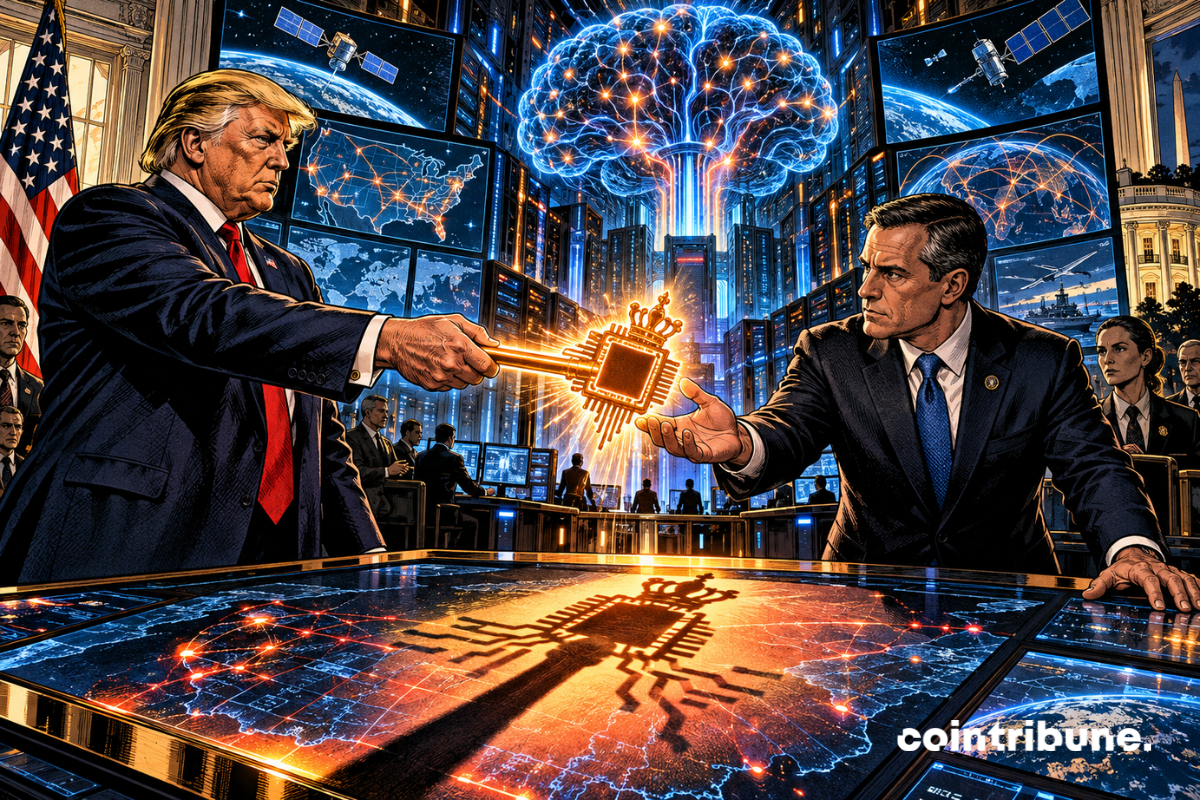
The militarization of cutting-edge language models is redefining the map of global technological power, turning computer code into a massive deterrent weapon. Artificial intelligence is now establishing itself as the heart of defense infrastructures. However, limited access to these technologies immediately causes deep geopolitical fractures. The recent restriction of foreign users by American industry leaders triggered an immediate industrial response in Asia. This regulatory decision, far from slowing the technological development of the countries concerned, served as a sovereign accelerator for Chinese laboratories.
Bolivia changes its monetary strategy after fifteen years of artificial stability. The country abandons its fixed peg to the dollar due to the decline of its reserves and economic pressure. This decision also revives the debate around financial alternatives like Bitcoin, as cryptocurrencies advance in economies facing currency tensions. The new exchange rate regime marks a new stage for the boliviano and transforms the country's monetary environment.
The analysis of weekly flows on spot crypto index funds reveals an unprecedented fracture within the sector, challenging the idea of a monolithic institutional block. This data is important because it shows that professional investors no longer blindly put their money into the two dominant assets, but are starting to choose growth alternatives.
BNB Chain surpasses Solana with $5.2B in tokenized stocks. A major turning point for tokenisation and real assets on blockchain.
Michael Saylor disrupts one of Strategy's founding principles with a new unprecedented financial framework. Between $2 billion share buybacks and possible Bitcoin monetization, this decision could transform the management of BTC cash reserves.
Shiba Inu (SHIB), the second largest memecoin in terms of market capitalization, is currently experiencing very strong turbulence that call into question its technical structure and shake traders during this first half of the year. While the asset has just recorded its worst monthly underperformance since January, this situation draws the industry's attention as it embodies an intense tug of war between an apparent graphical capitulation and discreet accumulation signals.
A question to start with. If tomorrow your crypto platform lost the right to operate in Europe, where would you go? It sounds theoretical. It is not. On July 1st, 2026, MiCA applies everywhere in the European Economic Area, and exchanges without approval will have to close their doors to EU customers. Kraken settled the issue long ago: license obtained in June 2025, from the Central Bank of Ireland. And to welcome all those who will have to move their cryptos in the coming weeks, the platform launches two offers. A contest with one million euros, and zero Futures fees on Kraken Pro for both new and existing Kraken users.
Polygon establishes itself in the race for stablecoin payments. The network processed about 79.25 billion dollars in May, across nearly 198 million transactions. An activity that allows it to overtake Solana and BNB Chain in the number of transfers.
Bitcoin is trading at 59,800 dollars this Monday, up 0.6% over 24 hours, but still below the psychological threshold of 60,000 dollars. The market structure remains bearish, despite a slight rebound in Solana and a lull in volatility indices. How long will sellers keep control?
The crypto market ends the second quarter of 2026 under extreme pressure. About 775 million dollars were stolen over 85 incidents, a record in terms of frequency. Two major attacks accounted for most of the losses, while DeFi saw its total value locked drop near 70 billion dollars.
The historic gap between the gigantic volumes of traditional finance and the actual adoption of blockchain technologies is set to close thanks to digital settlement infrastructures. This transition is accelerating as financial institutions seek smoother architectures to modernize aging cross-border payment networks. It is in this context of systemic transformation that Brad Garlinghouse, CEO of Ripple, spoke in an interview with CNBC, revealing strategic figures and an unprecedented commercial ambition for the Ripple protocol and its native asset, XRP.
The annual economic report of the Bank for International Settlements (BIS) warns about possible transformations of the global monetary landscape. Published in Basel, the document examines the role of stablecoins and their limits in current financial systems. The institution highlights the risk of dollarization in certain emerging economies when users favor digital assets linked to the US dollar. This analysis outlines the challenges related to indexed tokens and possible developments of private digital currency. The BIS considers that these innovations require an appropriate framework to evolve.
The apparent short-term volatility of financial markets sometimes conceals major statistical anomalies that only the most rigorous observers can spot. Bitcoin is currently trading around the critical threshold of 59,000 dollars, in a corrective phase that revives operators' anxiety. However, a purely quantitative analysis gives a completely opposite perspective on the asset. Such a situation is all the more true as there is a significant contrast between the general panic sentiment and historical mathematical indicators, which indicate that crypto is in an extreme undervaluation zone.
Bitcoin ETFs suffered $1.79B in withdrawals in one week. Analysis of the causes, consequences, and scenarios to watch.
Why is the 2026 crypto market faltering? Changpeng Zhao challenges conventional wisdom with three explanations: the Bitcoin cycle, artificial intelligence, and geopolitics. Another crucial question is brought up by his analysis: is Bitcoin still leading the market as a whole, or is its power eroding over time?
The technico-financial showdown that Strategy faces today against the macroeconomic realities of the market has just passed a critical threshold. This situation reveals the theoretical limits of an aggressive accumulation model that seemed infallible until now. While the company's valuation decreases unprecedentedly compared to its real assets, the choices of its leaders could redefine the very structure of corporate finance linked to cryptos.
Bitwise brutally strengthens its crypto bet on Hyperliquid. The asset manager transferred 1.775 million HYPE tokens to the protocol before staking them. The operation, estimated at around 114 million dollars, accompanies the rise of its Hyperliquid spot ETF launched in May.
Bitcoin continues to hold an important place in El Salvador's financial strategy, which continues its regular purchases despite changes in its regulatory framework. The country has just added new digital assets to its national treasury, confirming the continuity of its reserve policy. This new acquisition comes as sovereign cryptocurrency reserves remain closely monitored by market observers and institutional players around the world.
The crypto ranking experienced a rare shift on June 26. Tether's USDT briefly surpassed Ether in market capitalization, becoming the second cryptocurrency in the market behind Bitcoin. This reversal did not come from an increase in the USDT price, but from Ethereum's sharp drop to its lowest level in 2026.
Bitcoin miners watch their hashprice plummet like a failed soufflé, while difficulty spikes without mercy. What a contradiction—and yet, they hold their ground.
Major crises are often powerful revelations of the public utility of financial innovations, propelling cryptos far beyond their speculative dimension. This is exactly the scenario currently unfolding on the South American continent where, following the devastating earthquakes that struck Venezuela, the global ecosystem of these assets has mobilized at a lightning speed. In a context where traditional banking channels prove ineffective or heavily blocked, the speed, lack of borders and disintermediation offered by blockchain technology appear as crucial advantages for delivering aid.
A few days before July 1, 2026, the European Union has granted only 230 licenses under the MiCA regulation, leaving more than 80% of crypto actors without authorization. Spain has just closed the door to any extension of the transitional period. Will this countdown reshape the map of the European crypto market?
Bitcoin is going through a crucial structural adjustment phase that tests the resilience of the newest investors. In a financial environment accustomed to violent corrections, the sudden emergence of massive selling pressure rekindles fears of an imminent market purge. This situation occurs in a context of tightening global macroeconomic conditions and a marked disengagement of major American institutional players. It is essential to understand the dynamics underlying this capitulation movement to anticipate the short-term trajectory of the world’s leading crypto.
The financial market is going through a period of high tension as values related to digital assets undergo a marked correction. In this context, crypto becomes a particularly watched sector after the sharp decline of specialized stocks. Coinbase is among the affected companies, with a larger drop than several major American tech groups. This situation highlights the growing gap between cryptocurrency companies and the rest of the stock market. Investors now watch the performances of these players amid economic uncertainties and sector developments.
The verbal duels between iconic figures in the crypto industry often reveal the structural cracks of a market undergoing institutional transformation. During a particularly noteworthy media appearance on CNBC this Friday, Ripple CEO Brad Garlinghouse criticized Michael Saylor's Bitcoin accumulation strategy through his company Strategy, stating that this approach seriously harms the entire crypto ecosystem. This statement comes amidst an uncertain macroeconomic climate, where the leading crypto shows clear signs of weakness below the $60,000 mark, weakening financial architectures based on corporate over-indebtedness.
The refusal of Binance's MiCA license in Greece shakes the European crypto market. As the world's largest platform sees its access to the EU restricted, regulatory tensions rapidly intensify. Behind this decision, a larger power struggle pits institutions against crypto players, against the backdrop of European monetary transformation in a context of accelerating the digital euro and European financial control. Does the Binance case mark a turning point for the European financial system?
Bitget has launched the third edition of Anti-Scam Month alongside a new report on fraud in the multi-asset era. Developed with SlowMist, the study shows how scammers now combine artificial intelligence, social engineering, fake investment communities and several financial products within the same operation.